
| Spotlight on Excellence: Interview with the Best Reviewer of AgroFood 2025
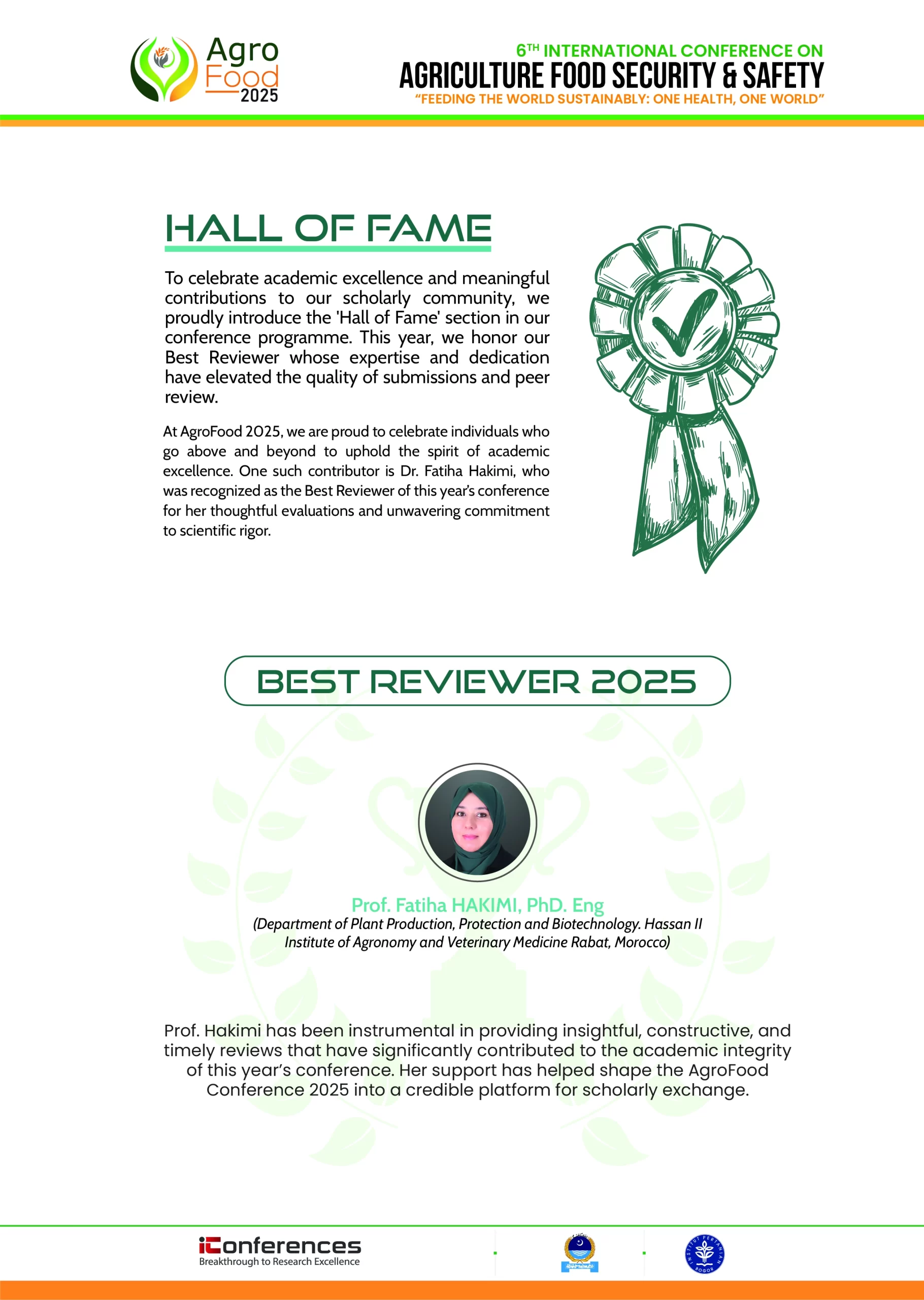
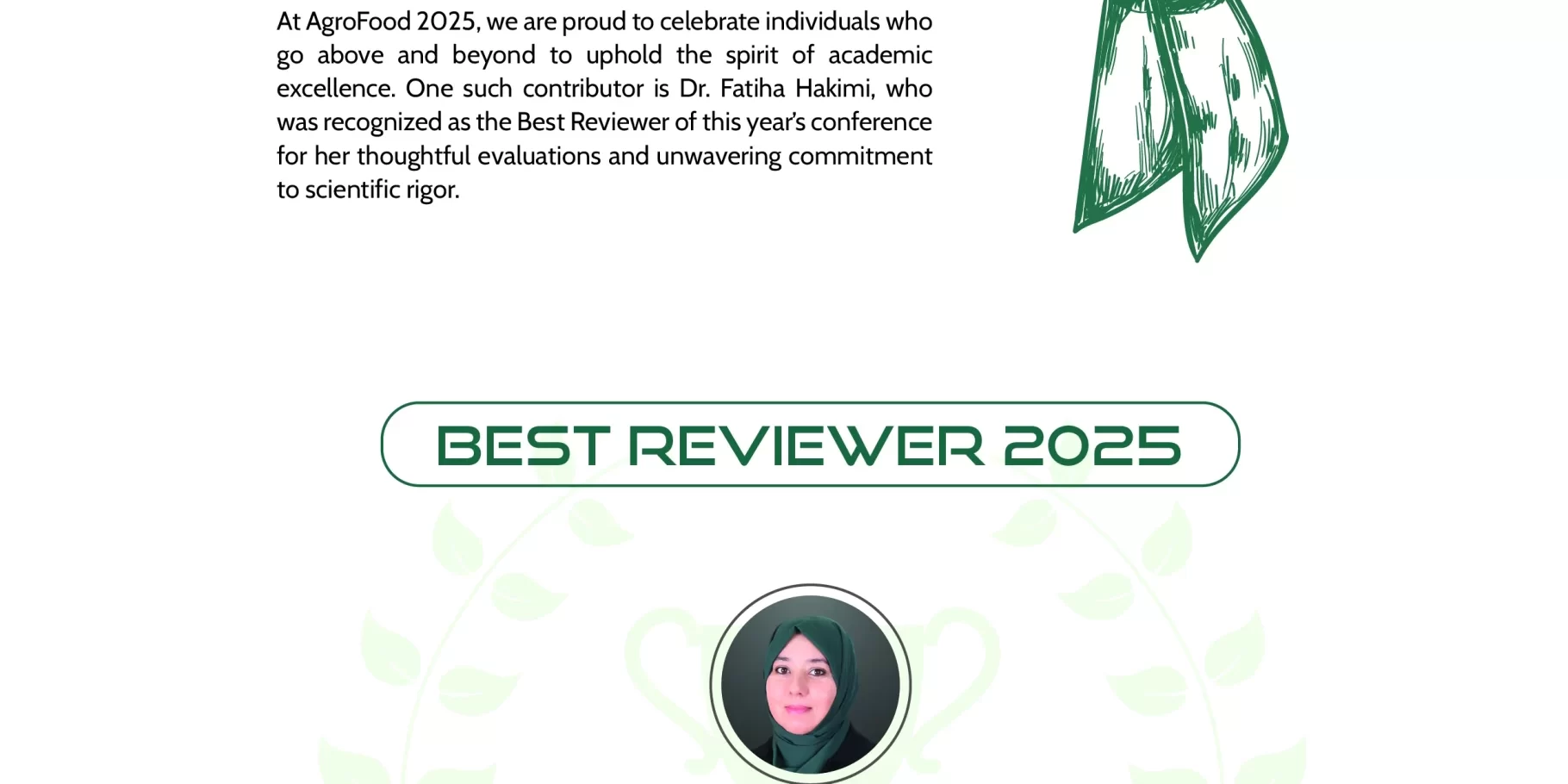
At AgroFood 2025, we are proud to celebrate individuals who go above and beyond to uphold the spirit of academic excellence.
One such contributor is Dr. Fatiha Hakimi, who was recognized as the Best Reviewer of this year’s conference for her thoughtful evaluations and unwavering commitment to scientific rigor.
In this exclusive interview, Dr. Fatiha Hakimi, shares her journey, insights, and advice for researchers across the globe.

Q. Can you briefly introduce yourself and your current academic role?
Answer:
I am Dr. Fatiha Hakimi, Associate Professor at the Hassan II Institute of Agronomy and Veterinary Medicine in Rabat, Morocco, within the Department of Plant Production, Protection, and Biotechnology. My academic and research work focuses on sustainable agricultural systems, integrating agroecological practices, efficient resource management, and resilience in urban and peri-urban agriculture. In addition to teaching and supervising theses, I participate in various national and international research projects and scientific committees.
Q. What inspired you to pursue a career in your field of expertise?
Answer:
Growing up in a semi-arid region, I witnessed firsthand the challenges that farmers face due to climate variability and resource constraints. This experience sparked my interest in finding practical, science-based solutions to make agriculture more sustainable and resilient, especially for small-scale farmers. My academic path, combining agronomy and environmental sciences, has allowed me to pursue this passion through research, teaching, and community engagement.
Q. What motivates you to engage in peer review for academic conferences and journals?
Answer:
Peer reviewing is an essential part of the scientific process. It allows me to stay up to date with new research developments, contribute to maintaining scientific rigor, and support fellow researchers in improving the quality of their work. I see it as a form of academic responsibility and also an opportunity for mutual learning.
Q. What do you usually look for when reviewing a research paper or abstract?
Answer:
I pay close attention to the clarity of the research question, the relevance of the topic, the soundness of the methodology, and the coherence of the results and conclusions. I also value originality, scientific rigor, and how the work contributes to solving real-world challenges in agriculture or food systems.
Q. What was your experience like reviewing submissions for AgroFood Conference 2025 and iConferences?
Answer:
It was a rewarding experience. I was impressed by the diversity of themes and the level of innovation presented in many submissions. Reviewing for these conferences allowed me to engage with emerging ideas and provide constructive feedback to help researchers enhance the clarity and impact of their work.
Q. In your opinion, what makes a submission stand out?
Answer:
A strong submission is one that addresses a relevant problem with a clear objective, presents a robust methodology, and delivers meaningful results. What really stands out is when the authors can link their findings to broader implications, such as sustainability, policy, or practical application for farmers or stakeholders.
Q. What are the most pressing or exciting research areas in agriculture and food systems today?
Answer:
Some of the most critical areas include climate-smart agriculture, agroecological transition, food system resilience, and digital innovations for precision farming. There is also a growing need to address sustainability in urban and peri-urban contexts and to better support smallholder farmers through inclusive and adaptive technologies.
Q. How can early-career researchers improve their academic writing and presentation skills?
Answer:
Practice and feedback are key. I encourage young researchers to read widely, attend scientific events, and engage with peers and mentors. Participating in writing workshops, publishing with co-authors, and presenting at conferences can help them develop clarity, structure, and confidence in their academic communication.
Q. What advice would you give to students considering a career in academia or research?
Answer:
Stay curious, be persistent, and align your research with real-world challenges. Academia offers a unique platform to create impact through knowledge, but it also requires resilience and continuous learning. Surround yourself with a strong support network and seek opportunities to collaborate across disciplines and borders.
Q. Any final message you'd like to share with the global research community?
Answer:
Collaboration and knowledge-sharing are more crucial than ever to address the complex challenges facing agriculture and food systems. I encourage researchers across the globe to embrace interdisciplinary approaches, engage with stakeholders, and work collectively to build resilient and sustainable futures for our communities and ecosystems.